
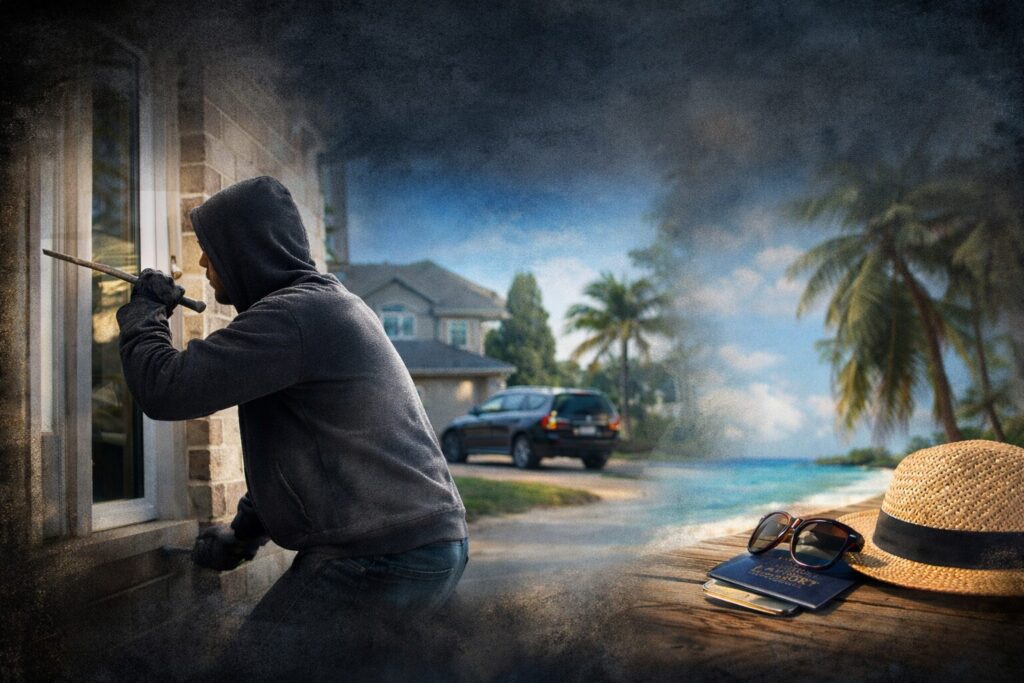
Keeping Your Home Secure While You’re Away
Vacations are supposed to lower your stress — not raise your blood pressure because you’re wondering what’s happening at home.
Here’s the reality: most burglaries aren’t high-level criminal masterminds. They’re crimes of opportunity. Someone notices a dark house, stacked mail, no cars in the driveway… and they take a shot.
And the numbers back that up.
When Burglaries Actually Happen
Most people picture break-ins happening at 2 a.m.
They don’t.
- About 65% of burglaries happen during the day, usually between 10 a.m. and 3 p.m. — when people are at work or school.
- Summer is peak season, partly because of travel and unsecured windows.
- Holiday periods see increased theft, especially valuables like jewelry and electronics.
Criminals go when it’s quiet, predictable, and convenient.
Let’s not be the easy house.
1. Lock the Boring Stuff (Because It Works)
Here’s something that surprises people:
- Around 34% of burglars walk right through the front door — no force required.
- About 23% use first-floor windows.
- Roughly 22% come through back doors.
That’s not elite tradecraft. That’s unlocked access.
Before you leave:
- Check that deadbolts fully extend.
- Add a security bar to sliding doors.
- Lock every window — especially first-floor ones.
Security isn’t flashy. It’s consistency.
2. Make It Look Like Someone’s Home
Many break-ins happen because the house looks empty.
And here’s the kicker:
- About 25% of homeowners admit leaving doors unlocked when away.
- Around 35% leave first-floor windows unlatched.
Opportunity drives crime.
So:
- Put lights and a TV on timers.
- Have a neighbor grab your packages.
- Pause mail if you’ll be gone a while.
- Leave a vehicle in the driveway if possible.
And maybe the biggest one: don’t post beach photos in real time. Save it for when you’re back.
3. Use Tech — But Test It
Cameras and alarms are great… if they work.
Before you leave:
- Arm the system and verify alerts are coming through.
- Check camera angles and night vision.
- Make sure remote login works.
Don’t discover a dead battery from 600 miles away.
4. Don’t Forget Digital Security
Physical and digital security are connected now.
- Use a strong Wi-Fi password.
- Update router firmware.
- Disable garage door remote access if it’s not needed.
You don’t want your “smart” home becoming someone else’s opportunity.
Final Thought
Security isn’t about paranoia. It’s about reducing opportunity.
You don’t need to turn your home into a fortress. You just need to make it harder than the one down the street.
That’s how civilian dads do it — practical, layered, and smart.
Stay aware. Stay prepared.
— Threat Vector Solutions
Sources & Data References
- FBI Uniform Crime Reporting (UCR) Program – Residential burglary statistics
- U.S. Department of Justice, Bureau of Justice Statistics (BJS) – Household Burglary Data
- Insurance Information Institute (III) – Seasonal burglary trends
- National Crime Prevention Council (NCPC) – Entry point and prevention data