Dry Fire: The Most Underrated Training You’re Not Doing Enough Of
If I could only choose one way to train with a handgun for the rest of my life…
It wouldn’t be live fire.
It would be dry fire.
No recoil.
No noise.
No brass flying.
No adrenaline spike.
And yet — dry fire is where real skill is built.
What Dry Fire Actually Is
Dry fire is structured practice with an unloaded firearm.
No ammunition in the gun.
No ammunition in the room.
No exceptions.
It is deliberate, focused repetition of:
- Draw stroke
- Grip establishment
- Presentation
- Sight alignment / dot acquisition
- Trigger press
- Reload mechanics
- Malfunction clearing (simulated)
- Safe re-holstering
Done correctly, it builds neural pathways that live fire simply reinforces.
Why Dry Fire Works So Well
1. It Removes Distraction
Recoil masks mistakes.
When the gun doesn’t move, you can clearly see:
- Sight movement during trigger press
- Grip inconsistency
- Trigger jerk
- Anticipation habits
Dry fire exposes flaws without hiding them behind recoil.
That honesty is powerful.
2. You Can Get 10x More Reps
Most people go to the range once or twice a month.
In a 200-round session, how many truly focused repetitions do you get?
Now compare that to:
- 15 minutes a night
- 5 days a week
- 50–100 perfect reps per session
That’s thousands of clean, intentional repetitions every month.
Skill is built through repetition — not noise.
Red Dots: Where Dry Fire Becomes a Force Multiplier
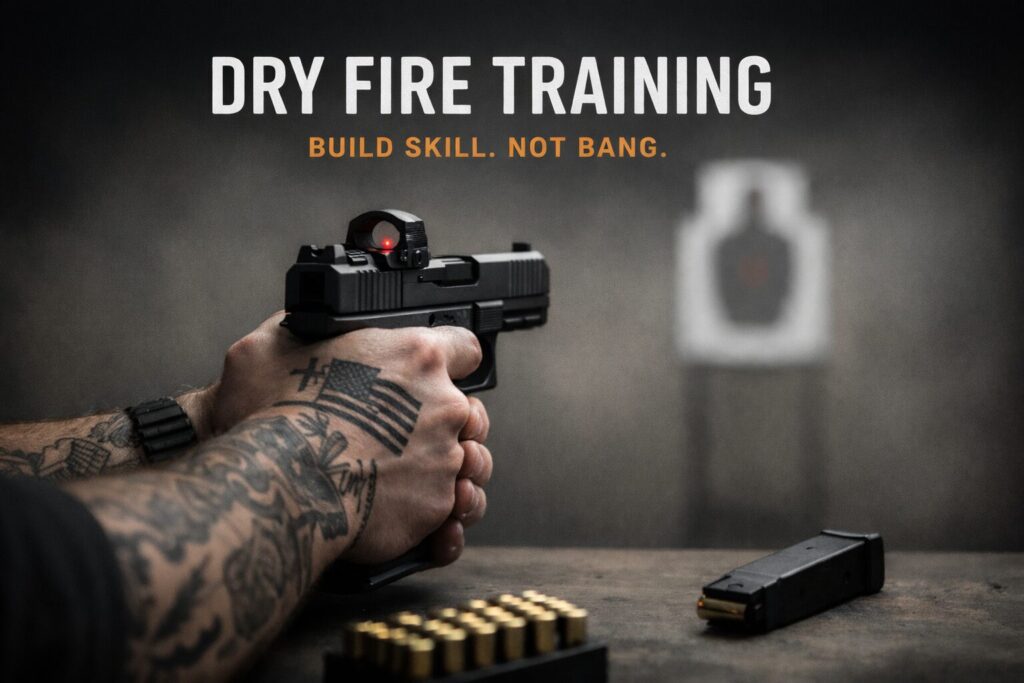
If you’re running a pistol-mounted optic, dry fire becomes even more valuable.
Why?
Because red dots are brutally honest.
If your presentation is inconsistent, the dot won’t be there.
If your grip shifts, the dot will bounce.
If you slap the trigger, the dot will dip.
Dry fire lets you:
- Refine a consistent presentation so the dot appears naturally
- Diagnose grip pressure issues
- Track dot movement during trigger press
- Build visual discipline (target focus, not dot chasing)
Many people think red dots are slower.
They’re not.
Inconsistent shooters are slower.
Dry fire bridges that gap.
Ten minutes a day drawing to a clean dot presentation will solve more “I can’t find the dot” issues than 500 rushed live rounds ever will.
3. It Builds Consistency in the Fundamentals
Your draw stroke doesn’t need recoil.
Your presentation doesn’t need recoil.
Your sight picture — whether irons or dot — doesn’t need recoil.
Your trigger control doesn’t need recoil.
Recoil management matters.
But if your fundamentals are inconsistent, recoil is the least of your problems.
4. It Builds Discipline
Dry fire requires intention.
There’s no steel ringing.
No immediate hit confirmation.
No ego boost.
It’s just you, the gun, and your standards.
That kind of training builds focus and accountability.
And that translates directly into live performance.
The Safety Standard (Non-Negotiable)
Dry fire is safe when done correctly.
It is dangerous when done casually.
My rules:
- Remove all ammunition from the room.
- Visually and physically inspect the chamber.
- Pick a safe direction.
- Do not “just one more rep” after reloading.
- When you’re done — you’re done.
Treat dry fire with the same respect as live fire.
Complacency is the only real risk.
A Simple 15-Minute Dry Fire Routine
If you don’t know where to start, try this:
5 minutes – Draw to sight picture (or dot)
Slow. Clean. Consistent.
5 minutes – Trigger press
Watch the front sight or dot. It should not move.
5 minutes – Draw to first clean press
Smooth. Controlled. No rushing.
Do this 4–5 days a week for a month.
Then go to the range.
You’ll notice the difference immediately.
The Civilian Advantage
Most of us are not professional shooters.
We have jobs. Families. Responsibilities.
Dry fire is accessible:
- No range fee
- No travel time
- No ammo cost
- No schedule coordination
You can build serious capability in your living room.
That’s an advantage — if you use it.
Final Thought
You don’t need more gear.
You don’t need another class (yet).
You need structured, consistent practice.
Start with dry fire.
Master the boring work.
The performance will follow.
—
Threat Vector Solutions
Capability built on discipline — not ego.